Silicotungstic acid, also known as tungstosilicic acid or tungstosilicic acid hydrate, is an inorganic compound composed of tungsten, silicon, hydrogen, and oxygen. It is an inorganic acid formed by hydrogen ions and silicotungstate anions, with the English name tungstosilicic acid hydrate or silicotungstic acid, molecular formula H?[Si(W?O??)?]·nH?O, molecular weight 2878.17, and CAS number 12027-38-2.
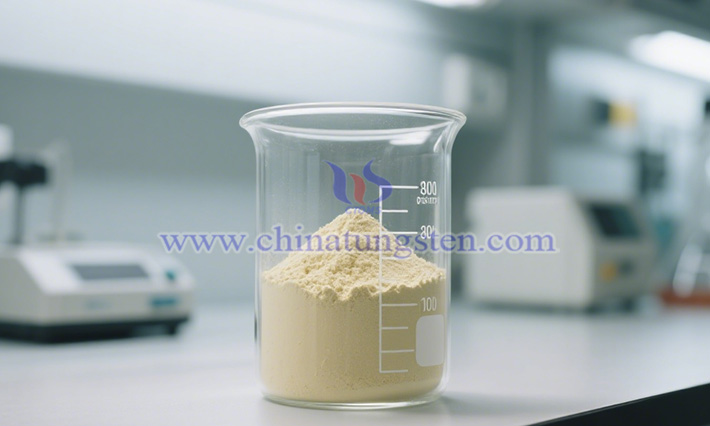
Silicotungstic acid appears as a white or pale yellow crystalline powder. It is non-toxic, non-flammable, but slightly irritating, with a purity of up to 98%, a density of 2.099 g/cm3, and a boiling point of 220°C. It is soluble in water, ethanol, and ether, and stable under normal temperature and pressure. However, when heated, it dissolves in its own crystal water, and it decomposes at around 600°C. It exhibits acidity, oxidative properties, and catalytic activity. Note: It should be stored in a sealed, dry place, away from light, open flames, and high temperatures.
Compared to the ether extraction process, the non-ether method is more suitable for producing silicotungstic acid due to its higher economic and environmental benefits. The non-ether method involves:
Conversion: Heating, stirring, and adjusting the pH of ammonium paratungstate to convert it into ammonium metatungstate.
Silicon Addition: Adding ammonium metatungstate to silicic acid and ammonia water, then heating, stirring, and adjusting pH to form a (NH?)?[SiW??O??] solution.
Ion Exchange: Performing cation exchange on the (NH?)?[SiW??O??] solution to obtain a H?SiW??O?? solution.
Evaporation and Crystallization: Evaporating and concentrating the H?SiW??O?? solution to crystallize it into the final H?SiW??O??·nH?O product.

Silicotungstic acid has diverse applications:
As a biochemical reagent, it can be used to prepare heavy liquids for mineral flotation or as a reagent for the precipitation and determination of alkaloids.
As a mordant, such as for basic aniline dye mordanting.
As a catalyst in organic synthesis, for example, in the reaction of acetic acid with ethylene to produce ethyl acetate, or in the oxidation of ethylene to produce acetic acid.
As a modifier for photochromic materials, such as modifying silica nanofilms.