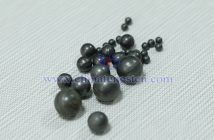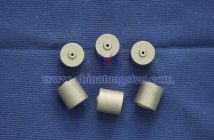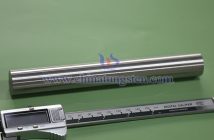
Tungsten cemented carbide balls are spherical products made of cemented carbide. Their core component is typically a tungsten carbide (WC) matrix, with metal binders such as cobalt (Co) and nickel (Ni). Their crystal structure is primarily determined by the phase structures of the tungsten carbide and the metal binder.
I. Crystal Structure of Tungsten Carbide (WC)
1. Crystal Type: WC belongs to the hexagonal crystal system and has a typical hexagonal close-packed (HCP) structure.
2. Atomic Arrangement:
Tungsten (W) atoms are located in specific positions in the crystal lattice, forming a hexagonal close-packed framework.
Carbon (C) atoms fill the interstitial spaces between tungsten atoms, forming stable WC molecules. 3. Structural Characteristics:
The WC crystal structure possesses high hardness and a high melting point, which underpins the excellent wear resistance and high-temperature resistance of tungsten cemented carbide balls.
The W-C bonds within the WC crystal are highly strong and directional, making it difficult for the WC crystal to slip when subjected to external forces, resulting in high hardness.

II. Crystal Structure of Metal Binders
1. Crystal Structure of Cobalt (Co):
Cobalt is the most commonly used binder in cemented carbide, and its crystal structure changes with temperature.
At room temperature, cobalt primarily exhibits a face-centered cubic (FCC) structure, which imparts excellent plasticity and toughness.
When the temperature rises above a certain value, the cobalt crystal structure transforms to a hexagonal close-packed (HCP) structure, but this transformation is generally not a major concern during the preparation and use of tungsten cemented carbide balls.
2. Crystal Structure of Nickel (Ni):
Nickel is also a potential binder used in cemented carbide, and its crystal structure is face-centered cubic (FCC). The addition of nickel further improves the corrosion resistance and high-temperature stability of tungsten cemented carbide balls.

III. Crystal Structure Characteristics of Tungsten cemented carbide balls
1. Two-Phase Structure: Tungsten cemented carbide balls consist of a WC crystal phase and a metal binder phase, forming a typical two-phase structure.
2. Complementary Performance:
The WC crystal phase provides high hardness and wear resistance.
The metal binder phase imparts excellent toughness and machinability to tungsten cemented carbide balls.
3. Microstructure: In tungsten cemented carbide balls, WC crystal particles are uniformly encapsulated by the metal binder, forming a continuous skeleton structure. This microstructure enables tungsten cemented carbide balls to disperse stress when subjected to external forces, preventing crack propagation and thus improving their fracture resistance.