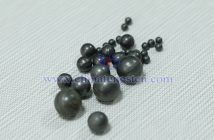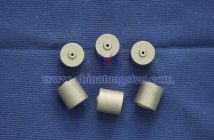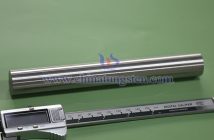
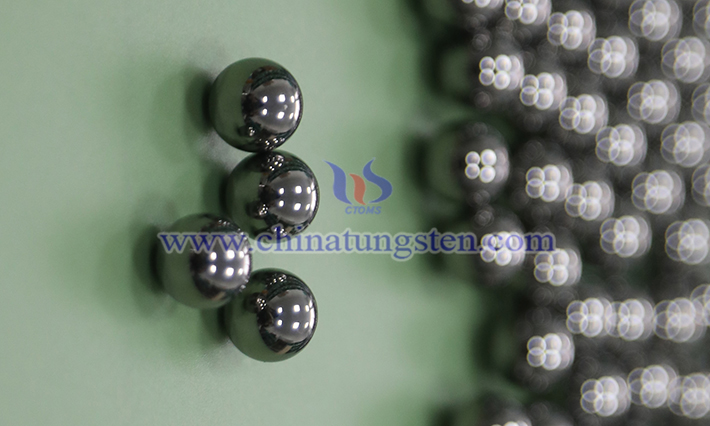
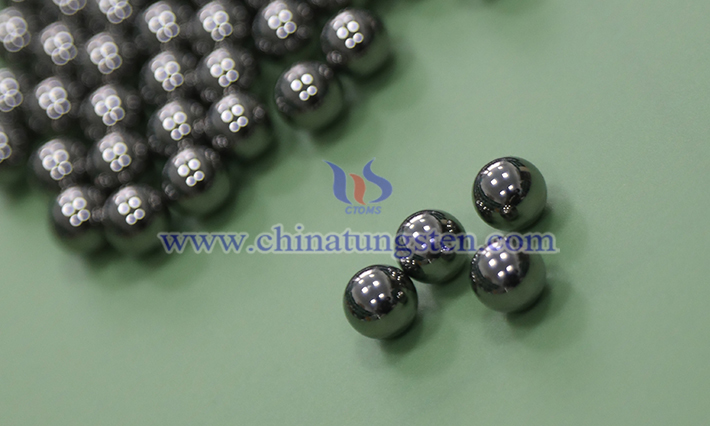
As the name suggests, tungsten cemented carbide balls are primarily made of cemented carbide. Cemented carbide is not a single metal, but rather a composite material composed of high-hardness, high-melting-point metal carbides and a metal binder, manufactured through a powder metallurgy process. Its core composition can be summarized as a "two-phase structure":
1. Hard Phase - Carbide
This is the core component that provides ultra-high hardness and wear resistance, typically comprising 70% to 97% of the total composition.
1. Tungsten Carbide (WC): This is by far the most important and most commonly used hard phase.
Purpose: WC particles provide extremely high hardness (reaching over HV 1700, two to three times that of steel), wear resistance, and compressive strength. The wear resistance of tungsten cemented carbide balls primarily stems from this phase.
Characteristics: The size, shape, and distribution of WC particles directly impact the properties of the final product. Finer particles generally increase the alloy's hardness and wear resistance, but toughness may decrease slightly.
2. Titanium Carbide (TiC): Added to some grades (such as the YT series), it improves the alloy's red hardness (the ability to maintain hardness at high temperatures) and oxidation resistance, but reduces flexural strength. It is commonly used in alloys for cutting steel.
3. Tantalum Carbide (TaC)/Niobium Carbide (NbC): It significantly improves the alloy's toughness, thermal shock resistance, and high-temperature performance, but at a higher cost.
II. Binder Phase
This is the "glue" that holds the hard carbide particles together, typically comprising 3% to 30% of the total composition.
1. Cobalt Metal:
Function: Cobalt metal melts during the sintering process, wets the carbide particles, and firmly bonds them together, forming a dense, integrated structure. It provides the toughness and impact resistance necessary for cemented carbide. Without cobalt as a binder, carbide powder cannot be formed and used.
Features: The cobalt content directly determines the toughness of cemented carbide.
Low cobalt content: Extremely high hardness and wear resistance, but relatively poor toughness, suitable for high-wear, low-impact applications (such as precision measuring tools and nozzles).
High cobalt content: Excellent toughness and strong impact resistance, but relatively low hardness, suitable for applications with some shock and vibration.
2. Nickel (Ni) or molybdenum (Mo): Environmentally friendly binder alternatives to cobalt, suitable for specialized environments (such as those requiring corrosion resistance or non-magnetic properties).