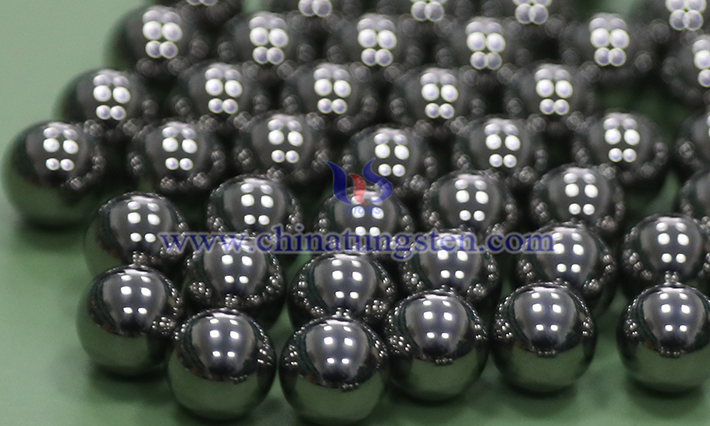
The friction coefficient of tungsten cemented carbide balls depends on the contact material, surface roughness, lubrication conditions, and environmental factors (such as temperature and humidity). The following is an overview of the friction coefficient of tungsten cemented carbide balls:
I. Friction Coefficient Range of Tungsten Cemented Carbide Balls
1. Dry Friction (Unlubricated): The static friction coefficient of carbide against carbide or carbide against steel is typically in the range of 0.3 to 0.6. The dynamic friction coefficient is slightly lower, approximately 0.2 to 0.5. The specific value depends on the surface treatment and roughness.
2. Lubrication Conditions: Under liquid lubrication (such as oil or water) or solid lubrication (such as graphite or molybdenum disulfide), the friction coefficient can be significantly reduced to 0.05 to 0.2, or even lower. 3. Special Environments:
Vacuum or High Temperature: The coefficient of friction may increase due to the loss of surface films (such as oxide films), reaching values as high as 0.8–1.0 or higher.
Low Temperature: In some cases, the coefficient of friction may decrease slightly due to changes in material hardness.

II. Factors Affecting the Friction Coefficient of Tungsten Cemented Carbide Balls
1. Contact Material: The coefficient of friction between tungsten cemented carbide balls and different materials (such as steel, ceramic, and polymer) varies significantly. For example:
Carbide-steel: The dynamic coefficient of friction is approximately 0.2–0.4 (unlubricated), which can be reduced to 0.05–0.15 with lubrication.
Carbide-carbide: The coefficient of friction is higher, approximately 0.4–0.6 (dry friction).
2. Surface Roughness: Polished tungsten cemented carbide balls have smoother surfaces and lower coefficients of friction; rough surfaces increase friction.
3. Lubricants: Using solid lubricants such as polytetrafluoroethylene (PTFE), graphite, or molybdenum disulfide can significantly reduce the coefficient of friction. 4. Environmental Conditions:
High temperatures may cause phase changes or surface property changes, affecting the coefficient of friction. For example, tungsten carbide may form an oxide film at high temperatures, reducing the coefficient of friction.
Humidity may increase adhesion, slightly increasing the coefficient of friction.
III. Methods for Measuring the Coefficient of Friction of Tungsten Cemented Carbide Balls
1. Incline Method: Place a tungsten cemented carbide ball on an inclined surface and gradually increase the inclination angle until it slides. The coefficient of friction μ = tanθ (where θ is the friction angle).
2. Drag Method: Apply a horizontal force, measure the force required for sliding, and calculate the ratio of the friction force to the normal pressure.