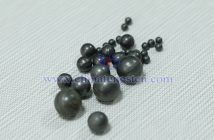
Low-temperature resistant cemented carbide balls are spherical materials made primarily of micron-sized metal carbide powders such as tungsten carbide (WC) and titanium carbide (TiC), with binders such as cobalt (Co), nickel (Ni), or molybdenum (Mo), sintered using powder metallurgy processes. Their core characteristic lies in their stability and performance retention under low-temperature conditions, making them key components for precision manufacturing, polar engineering, and other low-temperature applications.

I. Low-Temperature Adaptability: Dual Guarantee of Materials and Processes
The low-temperature performance of cemented carbide stems from its unique crystal structure and the choice of binder. The tungsten carbide matrix maintains high hardness and elastic modulus at low temperatures, while the cobalt-based binder, through optimized proportions (e.g., YG6 containing 6% cobalt, YG8 containing 8% cobalt), balances low-temperature brittleness and toughness. Furthermore, the vacuum sintering process eliminates internal porosity, preventing stress concentration caused by low-temperature shrinkage.
II. Cryogenic Applications: Cross-Domain Coverage from Polar Regions to Deep Space
Polar Equipment: In Antarctic research stations, cemented carbide balls are used in cryogenic valve seals. They can withstand continuous low temperatures and their wear resistance is several times, even tens of times, greater than that of traditional rubber seals.
Aerospace: In cryogenic pumps for liquid hydrogen/liquid oxygen rocket engines, cemented carbide balls serve as bearing balls. They maintain a hardness of HRA90 or higher even in cryogenic environments, ensuring propellant delivery stability.
Precision Instruments: The transmission components within quantum computing cryogenic thermostats utilize cemented carbide balls with a thermal expansion coefficient as low as 5×10??/℃, avoiding positioning errors caused by temperature fluctuations.

III. Performance Advantages: Comprehensive Competitiveness in Cryogenic Environments
Dimensional Stability: In cryogenic environments, cryogenic cemented carbide balls do not significantly shrink or expand due to sudden temperature drops, maintaining precise dimensional specifications and ensuring the accuracy of equipment operation.
Fatigue resistance: Even under prolonged low-temperature and frequent load conditions, this cemented carbide ball is not prone to fatigue cracks, ensuring continuous and stable operation and extending component lifespan.
Corrosion resistance: Facing various corrosive media in low-temperature environments, the low-temperature resistant cemented carbide ball, with its dense structure and stable composition, effectively resists corrosion and maintains its excellent performance.