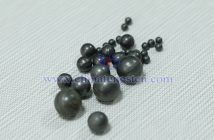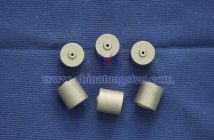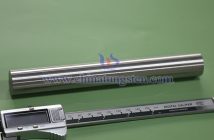
Cemented carbide balls for balancing instruments are spherical elements sintered using powder metallurgy processes. They are made with high-hardness metal carbide powders such as tungsten carbide (WC) as the matrix and cobalt (Co) or nickel (Ni) as the binder. Their core characteristics are highly compatible with the precision measurement requirements of balancing instruments. Specific applications and advantages are as follows:

I. Matching of Cemented Carbide Ball Material Properties with Balancing Instrument Requirements
High Hardness and Wear Resistance: The hardness of cemented carbide balls is generally between HRA 86-93, with some high-performance products (such as YG6x) reaching ≥90.5 HRA, which is 1.2-1.5 times the hardness of traditional steel balls. In balancing instruments, when used as probes or standard parts, they can withstand high-frequency contact friction with the surface of the measured object for extended periods, reducing measurement errors caused by wear.
Dimensional Stability and Corrosion Resistance: Cemented carbide balls maintain shape and accuracy stability even in extreme environments (such as high temperature, high pressure, and corrosive media). In optical measurement systems or laser interferometers, when used as a standard sphere calibration instrument, it ensures that resolution and repeatability are unaffected by environmental interference.
High-precision machining capability: Carbide spheres can be machined to extremely high roundness and surface finish (Ra < 0.01 μm), meeting the stringent requirements of balancing instruments for probe contact accuracy and standard part dimensional consistency.

II. Typical Application Scenarios of Carbide Spheres in Balancing Instruments
Probes and Probes: As a core component of contact probes, carbide spheres are widely used in coordinate measuring machines, roundness testers, and other equipment. Their high hardness and low coefficient of friction reduce wear on the surface of the measured object, ensuring long-term measurement consistency.
Standard Parts and Calibration: Due to their dimensional stability, carbide spheres are often used as standard references in laser interferometers and optical measurement systems. By comparing the geometric parameters of the standard sphere with those of the measured object, the instrument's resolution and repeatability can be verified, improving detection accuracy.
Bearings and Guide Components: In high-end balancing instruments, carbide spheres can serve as miniature bearings or guide elements, supporting the smooth operation of the instrument's moving parts. Its bending resistance and wear resistance reduce frictional vibration and improve measurement stability.
III. Technological Advantages and Industry Value The application of cemented carbide balls significantly improves the measurement accuracy, equipment lifespan, and reliability of balancing instruments. Compared to traditional steel balls, its wear resistance is increased by tens to hundreds of times, reducing maintenance costs and enabling it to withstand harsher industrial environments. In high-end manufacturing fields such as aerospace, automotive manufacturing, and semiconductors, cemented carbide balls have become an indispensable core component of balancing instruments, providing crucial technical support for the inspection of precision parts.