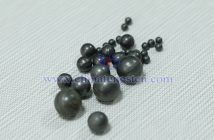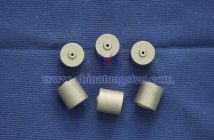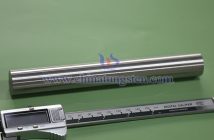
Cemented carbide bearing balls primarily refer to precision spheres made of tungsten carbide-based cemented carbide (usually WC-Co or WC-Ni series). They are widely used in high-end bearings (such as high-speed machine tool spindles, aerospace, and precision instruments), and their physical properties are far superior to traditional bearing steel balls (GCr15, etc.).
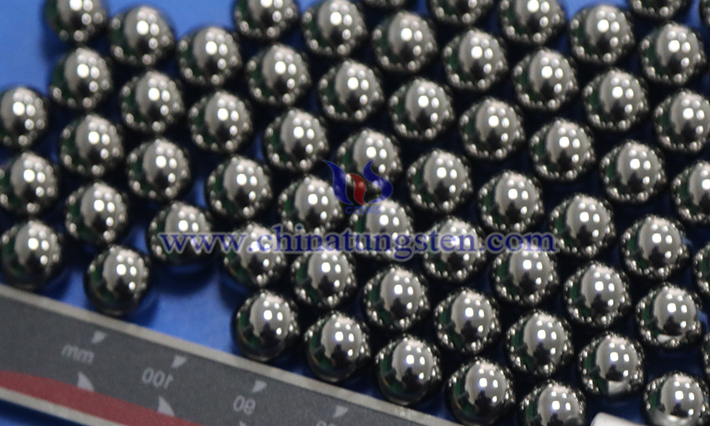
The most prominent characteristics of cemented carbide bearing balls are their extremely high hardness and wear resistance. Their Vickers hardness is typically more than twice that of steel balls, almost approaching that of natural diamond. Under high-speed rotation and heavy load conditions, the surface experiences almost no wear, significantly extending bearing life and reducing maintenance frequency.
Secondly, they possess excellent corrosion resistance. The cobalt or nickel bonded phase enables the ball bearings to operate stably for extended periods in harsh chemical environments such as acids, alkalis, seawater, and wet hydrogen, while ordinary steel balls quickly exhibit pitting or generalized corrosion under the same conditions. This is the main reason why cemented carbide (CLC) ball bearings are commonly used in chemical pumps and marine equipment bearings.
Density is another significant characteristic of cemented carbide (CLC) ball bearings, approximately twice that of steel balls. While this high density results in greater centrifugal force requiring special design at extremely high speeds, it also significantly improves the bearing's dynamic stiffness and vibration resistance, leading to smoother equipment operation and higher machining precision.

The extremely low coefficient of thermal expansion, only about 1/2 to 1/3 that of steel, results in minimal dimensional change under conditions of drastic temperature rise, ensuring stable bearing clearance and preventing jamming or excessive clearance due to thermal expansion and contraction. This is particularly crucial for high-speed precision spindles.
The extremely high modulus of elasticity and excellent rigidity result in minimal deformation under load, contributing to improved bearing load-bearing capacity and rotational accuracy. Simultaneously, it possesses extremely high compressive strength and exhibits virtually no plastic deformation, making it suitable for withstanding extremely high contact stress and impact loads.
The surface finish is easily machined to a mirror level, and due to the material's inherent hardness, the polished surface maintains ultra-low roughness over a long period, resulting in a very low coefficient of friction, low rolling resistance, and minimal heat generation, making it ideal for ultra-high-speed and ultra-precision applications.