
Tungsten alloy collimator is a core component in ray imaging and detection systems. Its primary function is to geometrically constrain and directionally control the ray beam, allowing only rays that follow the preset path to effectively reach the detection area while maximally blocking scattered and stray rays, thereby significantly improving imaging resolution and detection signal-to-noise ratio. Its working principle is based on the excellent ray attenuation characteristics of tungsten alloy combined with a precisely designed channel structure; the two complement each other to regulate ray propagation behavior.
From a material perspective, tungsten alloy is the preferred material for collimators mainly due to its high density, environmental friendliness, and non-toxicity, as well as the high atomic number of tungsten. Tungsten has an atomic number of 74, giving it strong photoelectric absorption and Compton scattering capabilities for X-rays and γ-rays. Tungsten alloys typically contain more than 90% tungsten, thus exhibiting excellent shielding performance against rays. At the same time, tungsten alloy has a density of approximately 17 g/cm3, significantly higher than lead’s 11.34 g/cm3, meaning thinner thickness and lighter overall weight are required for the same shielding effectiveness, effectively improving equipment compactness and mobility. Most importantly, tungsten alloy is non-toxic and non-radioactive, complying with regulations and green manufacturing requirements for medical devices, nuclear instruments, and clean environments. It is the synergy of these advantages that has enabled tungsten alloy to gradually replace lead in high-precision, high-safety ray control applications and become the recognized mainstream material.
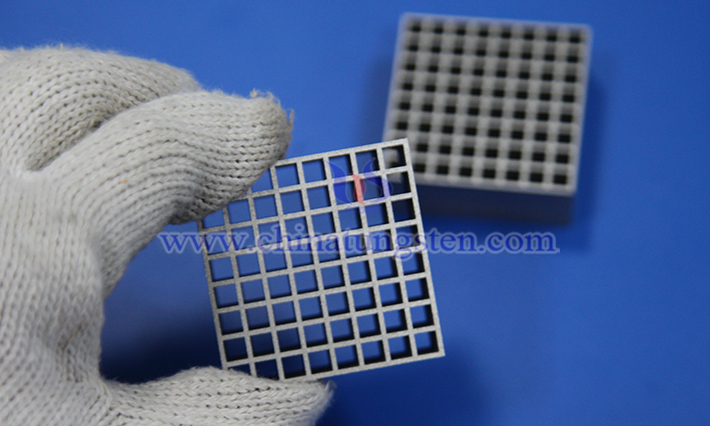
The working mechanism of a collimator can be summarized as the synergistic effect of “selective transmission and shielding.” The device usually consists of one or more tungsten alloy plates with a large number of slender channels arranged in a specific pattern. These channels form the only paths through which rays are allowed to pass. When a ray source emits near-spherical radiation, the vast majority of rays deviating from the target direction collide with the tungsten alloy solid between channels, undergoing multiple processes inside the solid such as photoelectric absorption, Compton scattering, or pair production, dissipating energy effectively and making it difficult to penetrate to the detection surface, thus achieving reliable non-axial shielding. Only rays that are highly aligned with the channel axis or have a very small angle deviation can pass unobstructed through the channels, forming a highly directional collimated ray beam at the detection surface.
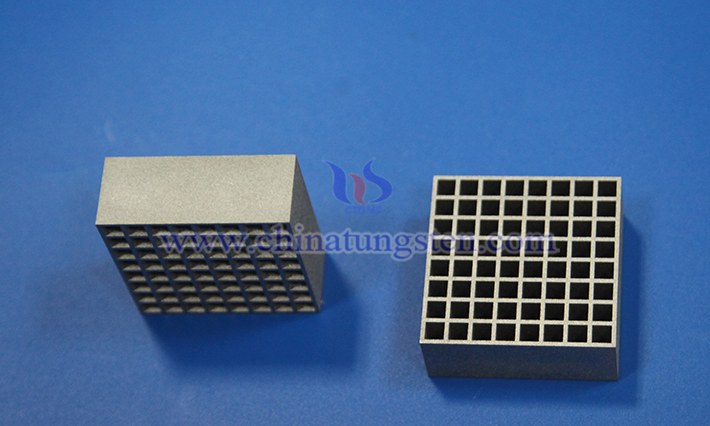
The geometric parameters of the channels determine collimation performance. The greater the ratio of channel length to aperture, the lower the tolerance for incident angle and the higher the parallelism and directional purity of the outgoing beam. The cross-sectional shape of the channels further defines the spatial distribution of the outgoing beam—for example, circular holes produce circular beam spots, while square or fan-shaped holes produce rectangular or fan-shaped beam spots to meet different imaging geometry requirements.
Different application fields have varying emphases on collimation performance. In medical imaging and radiation therapy, collimators must ensure sufficient useful ray flux to obtain clear images or precise dose distribution while strictly limiting peripheral leakage to protect healthy tissue. In industrial non-destructive testing, greater emphasis is placed on high angular selectivity to enhance the contrast of tiny defects. In nuclear instrument spectroscopy or security inspection equipment, collimators are often designed with extremely narrow fields of view to suppress environmental background and cosmic ray interference.