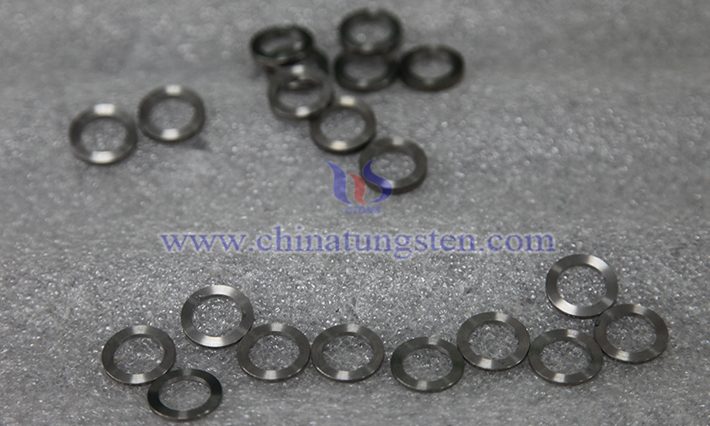
Tungsten Alloy Ring is a high-density annular component primarily composed of tungsten (typically 85%–98% by weight), with binder phases such as Ni-Fe, Ni-Cu, Ni-Co, or Ni-Fe-Mo, manufactured through powder metallurgy or copper-infiltration processes. It finds extensive use in aerospace, medical devices, precision instruments, industrial balancing, and radiation shielding applications. What are the key characteristics of tungsten alloy rings?

First, high density. The density of tungsten alloy rings generally ranges from 17.0 to 18.8 g/cm3. This high-density property allows them to occupy minimal volume for a given mass, making them the preferred material for equipment miniaturization and center-of-gravity control.
Second, high strength combined with good toughness. Typical tensile strength of tungsten alloy rings lies between 800 and 1200 MPa, with elongation ranging from 8% to 25%, far superior to the brittleness of pure tungsten. The continuous tungsten particle skeleton provides high hardness and wear resistance, while the binder phase imparts strong plastic deformation capability, preventing brittle fracture under significant impact, vibration, or centrifugal forces. This makes them suitable for high-speed rotating components such as flywheel rings, gyroscope rings, and engine balance rings.
Third, controllable magnetic properties. By adjusting the binder phase composition, tungsten alloy rings can achieve tailored magnetic behavior from weakly magnetic to fully non-magnetic. The W-Ni-Fe system exhibits certain ferromagnetism and is suitable for applications requiring magnetic response or positioning; the W-Ni-Cu or W-Ni-Mo systems are non-magnetic, meeting the zero-tolerance magnetic interference requirements of MRI-compatible collimator rings, magnetic-bearing retainer rings, and non-magnetic gyroscope components.
Fourth, excellent high-temperature stability and thermal shock resistance. Tungsten alloy rings have a high recrystallization temperature, retaining strength and hardness with minimal degradation at elevated temperatures and possessing a low coefficient of thermal expansion that matches well with many high-temperature alloys. They maintain structural integrity during rapid thermal cycling, making them ideal for gas turbine balance rings, plasma-facing component rings, and support rings in high-temperature vacuum equipment.
Fifth, outstanding radiation shielding performance. Tungsten alloy rings exhibit high linear attenuation coefficients for γ-rays and X-rays, and efficient neutron absorption can be achieved by incorporating elements such as B, Gd, or Sm.
Sixth, superior corrosion resistance and biocompatibility. The W-Ni-Cu system demonstrates corrosion resistance close to that of noble metals in seawater, acids, alkalis, and physiological saline environments. The W-Ni-Fe system, after appropriate passivation, also exhibits excellent atmospheric corrosion resistance.
Seventh, good machinability. Compared with pure tungsten, tungsten alloy rings can be precision-formed using conventional machining methods such as turning, milling, grinding, drilling, and wire electrical discharge machining.