Tungsten alloy rings and titanium alloy rings are both common annular functional components in aerospace, medical devices, precision instruments, and deep-sea equipment. However, they exhibit significant differences in material nature, performance emphasis, and application boundaries. Rather than directly replacing each other, they are complementary, and the actual material selection often depends on the specific priority ranking of density, strength, stiffness, corrosion resistance, and biocompatibility required by the operating conditions.
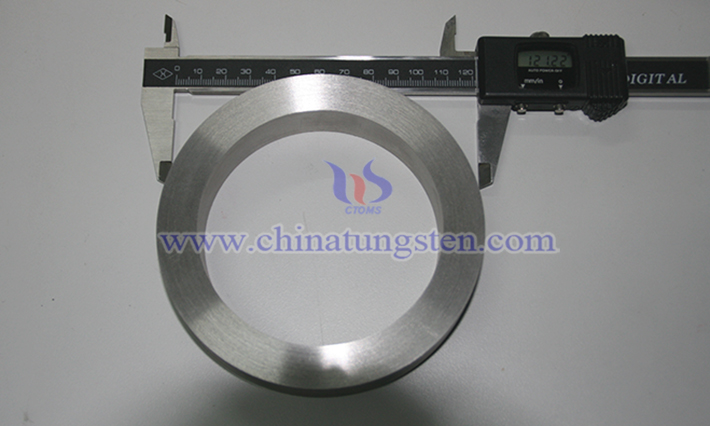
Tungsten alloy rings are tungsten-based with nickel-iron or nickel-copper as the binder phase, with densities typically ranging from 17.0 to 18.8 g/cm3. Titanium alloy rings, in contrast, are titanium-based, with common grades including TC4 (Ti-6Al-4V), TC11, TA15, etc., and a density of approximately 4.5 g/cm3. In applications requiring equivalent counterweight performance, tungsten alloy rings can achieve the target mass in a significantly smaller volume than titanium alloy rings due to their much higher density.
Titanium alloy rings hold a clear advantage in structural components subjected to tension, bending, or alternating loads thanks to their excellent specific strength (strength-to-density ratio) and high fatigue limit. Although tungsten alloy rings possess respectable absolute strength, their specific strength is markedly lower due to their high density. They are therefore better suited to loading conditions dominated by compression or shear rather than large-span tension or lightweight structures.
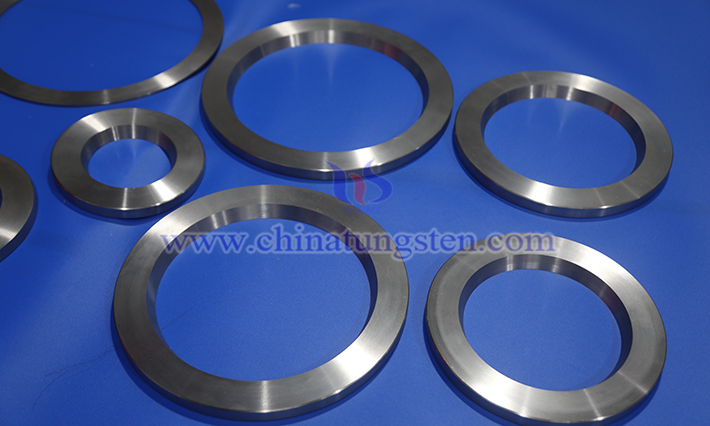
In terms of corrosion resistance and biocompatibility, titanium alloy rings are renowned for their outstanding resistance to seawater pitting, stress corrosion cracking, and excellent tissue compatibility, making them the preferred material for deep-sea Christmas trees, pressure hulls of manned submersibles, and orthopedic implant rings. Tungsten alloy rings also demonstrate good corrosion resistance in normal atmospheric and freshwater environments—particularly the W-Ni-Cu system—but the binder phase remains susceptible to pitting risk in high-concentration chloride-containing seawater or strongly oxidizing acids.
High-temperature performance is a strong advantage of tungsten alloy rings. Their recrystallization temperature is far higher than that of titanium alloys, enabling them to retain high strength and dimensional stability at elevated temperatures, whereas titanium alloys undergo significant softening and oxidation. As a result, tungsten alloy rings are the material of choice for high-temperature balance rings in gas turbines, throat-liner retaining rings in scramjet engines, and support rings in high-temperature vacuum equipment.