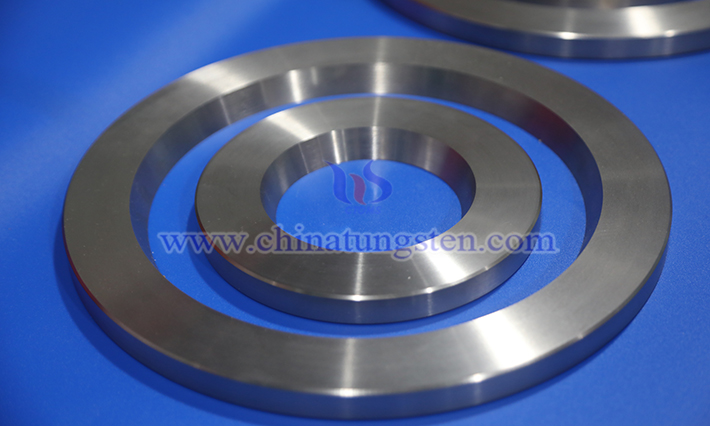
Tungsten alloy rings and steel rings are both common annular functional components in engineering, but they differ significantly in material nature, performance emphasis, and application boundaries. A direct comparison clearly reveals the irreplaceable role of tungsten alloy rings in specific high-end scenarios and the economic advantages of steel rings in conventional structural applications.

Tungsten alloy rings are primarily composed of tungsten, with nickel-iron or nickel-copper as the binder phase, forming a high-density composite material with a density stably ranging from 17.0 to 18.8 g/cm3. In contrast, steel rings are based on iron-carbon alloys, encompassing carbon steel, alloy steel, stainless steel, and maraging steel, with densities concentrated around 7.8–8.0 g/cm3. To achieve the same mass, the volume of a tungsten alloy ring is approximately 40%–45% that of a steel ring. This overwhelming volume-to-weight ratio advantage makes tungsten alloy rings the practical choice in space-constrained applications requiring small volume to provide large rotational inertia, centrifugal force, or ballast mass.
Tungsten alloy rings exhibit good corrosion resistance in normal atmospheric and freshwater environments, with the W-Ni-Cu system performing particularly stably. However, the metallic binder phase in their structure remains susceptible to selective corrosion in harsh media such as high-concentration chloride ions or strongly oxidizing acids. Therefore, in such environments, tungsten alloy rings often require surface plating or passivation treatments to achieve protection levels comparable to stainless steel. In comparison, stainless steel rings, thanks to their self-formed dense passive film, possess excellent resistance to pitting and stress corrosion cracking, enabling them to maintain long-term surface integrity and stability in demanding clean or corrosive environments such as marine, chemical, food, and medical applications.
Steel rings demonstrate outstanding comprehensive mechanical properties, with tensile strength exceeding 1000 MPa, while offering good elongation and impact toughness. These characteristics make them dominant in structural components subjected to complex loading (such as tension, bending, torsion, and alternating stress). In contrast, although tungsten alloy rings possess relatively high strength, their specific strength (strength-to-density ratio) is significantly lower due to their much higher density. Consequently, tungsten alloy rings are more suitable for applications involving compressive, shear, or localized concentrated loads, whereas they are not the preferred choice in large-span tension or ultra-lightweight structures requiring high specific strength.
In terms of high-temperature performance, tungsten alloy rings and steel rings exhibit marked differences. Tungsten alloys, benefiting from their high melting point, retain excellent structural strength and creep resistance at elevated temperatures, but must be used in vacuum or inert atmospheres to prevent oxidation. In contrast, heat-resistant steel rings, through alloying, deliver better overall performance in medium- to high-temperature oxidizing environments, including superior oxidation resistance and long-term strength. The selection between the two depends on the specific operating temperature, environmental medium, and service life requirements.