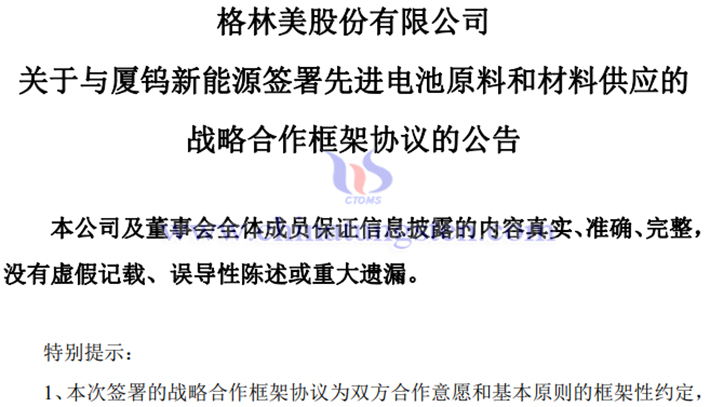
Recently, GEM released an announcement stating that the company has for many years been the most important material supplier to XTC New Energy, and the two parties have always maintained a good strategic cooperative relationship. This time, based on the principle of equality and mutual benefit, both parties signed a strategic cooperation framework agreement on October 24, 2025, unanimously agreeing to give full play to their respective advantages, jointly respond to the global market’s demand and challenges for ultra-high specific energy battery materials, and build an ultra-high specific energy battery materials industry consortium. According to the strategic cooperation framework agreement, from 2026 to 2028, the company expects to supply XTC New Energy with 150,000 tons of various battery material products each year, totaling 450,000 tons over the three years.
The announcement shows that from 2026 to 2028, GEM expects to supply XTC New Energy with 150,000 tons per year of various battery raw materials and material products, including cobalt chloride supply and demand of approximately 36,000 tons/year, nickel sulfate supply and demand of approximately 36,000 tons/year, cobalt tetroxide supply and demand of approximately 18,000 tons/year, ternary precursor supply and demand of approximately 36,000 tons/year, lithium carbonate/lithium phosphate supply and demand of approximately 24,000 tons/year, all of the above including recycled materials. GEM will guarantee supply according to XTC New Energy’s demand, with a total supply of 450,000 tons over the three years.
Both parties agree to carry out technical research, industrial chain supply cooperation and capital cooperation in the fields of resource recycling and reutilization, green nickel resource development, power battery and consumer battery raw materials and material manufacturing, etc., to acquire advantageous resources, drive in-depth cooperation in business, technology and capital throughout the upstream and downstream of the industrial chain, ensure supply stability and cost advantages, and build an integrated industrial chain with global competitiveness. Through recycling and remanufacturing related products, they will achieve green and low-carbon development and better meet the global new energy industry’s certification requirements for carbon footprint.

Both parties agree to conduct in-depth cooperation on products such as ternary precursors for batteries, cobalt tetroxide, solid-state lithium battery precursors (including new structures and new materials for solid-state batteries), lithium-rich manganese-based precursors, etc., as well as on existing technologies for cathode material development and future forward-looking technology development and certification. They will efficiently integrate the resources and advantages of both sides, explore the establishment of a resource-sharing and collaborative R&D cooperation mechanism, reduce production costs, share market economic benefits, jointly cope with challenges in the terminal market, and achieve mutual benefit and win-win results.