Recently, a breakthrough research achievement completed through cooperation between Heilongjiang University, Tsinghua University, and the National University of Singapore has been officially published in Nature, successfully overcoming the worldwide challenge of efficient electroluminescence in insulating rare earth nanocrystals. This research provides key core technical support for achieving China's strategic transformation of rare earth resources from "raw material exports" to "high-value-added technology output".
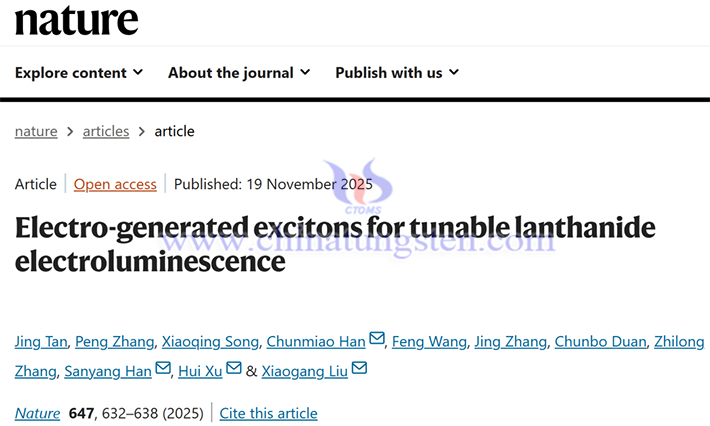
Nature website article screenshot
Rare earths are irreplaceable strategic resources, known as the "industrial vitamins". China has advantages in rare earth resource reserves and smelting, but still faces industrial bottlenecks in end-use high-end functional materials and devices. Lanthanide-doped nanocrystals, although possessing excellent characteristics such as high color purity and good stability as ideal luminescent materials, cannot be directly lit by current due to their inherent "insulating" properties, and their high-value optoelectronic applications have long been hindered.
Facing this bottleneck that restricts rare earth materials from advancing to high-end applications, the research team innovatively proposed an organic semiconductor sensitization strategy, using functionalized organic ligands as a "photoelectric bridge" to successfully transfer energy precisely and efficiently to insulating rare earth nanocrystals, achieving efficient luminescence under current drive.

Schematic diagram of organic-inorganic hybrid luminescent unit design and energy transfer mechanism (provided by research team)
This technology demonstrates huge application potential: electroluminescent device efficiency increased by 76 times, and full-spectrum luminescence can be achieved in a single device through rare earth ion regulation. This marks a key breakthrough in China's rare earth high-end optoelectronic applications, providing a new material system for developing independently controllable ultra-high-definition displays, near-infrared communications, biomedical and other next-generation information technologies.
This technology demonstrates huge application potential: electroluminescent device efficiency increased by 76 times, and full-spectrum luminescence can be achieved in a single device through rare earth ion regulation. This marks a key breakthrough in China's rare earth high-end optoelectronic applications, providing a new material system for developing independently controllable ultra-high-definition displays, near-infrared communications, biomedical and other next-generation information technologies.
Source: CCTV News Client