According to CTIA GROUP LTD, on November 25, Lynas Rare Earths, the largest rare earth producer overseas, announced that due to a severe power supply interruption, its Kalgoorlie processing plant in Western Australia will experience a sharp reduction in capacity, with an expected one-month capacity gap this quarter.
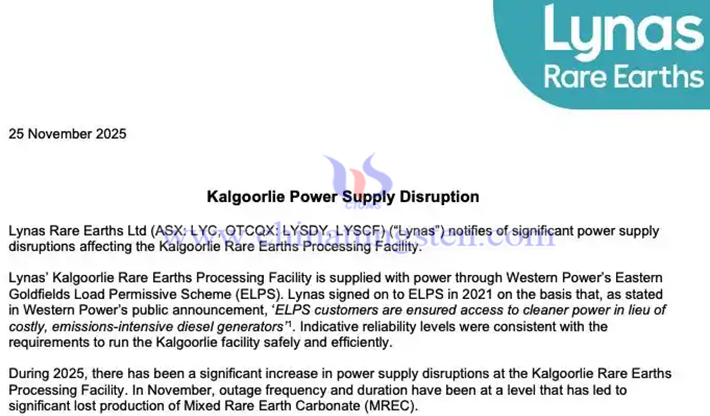
Under the global trend of countries actively reducing dependence on Chinese rare earths, Lynas originally planned to expand capacity, and this sudden capacity gap may adversely affect its layout. Reuters reported that the number of power outages at Lynas' Kalgoorlie plant in 2025 has increased significantly, and the November blackout has led to a substantial reduction in mixed rare earth carbonate (MREC) production.
It is reported that the Kalgoorlie processing plant is positioned in the rare earth value-added processing stage, with its core function being to receive rare earth concentrates from the Mount Weld mine for mid-stream purification, and it has the capability to provide third-party toll processing for future rare earth projects. At the Kalgoorlie plant, rare earth concentrates undergo cracking and leaching processes to ultimately produce mixed rare earth carbonate (MREC), which is then transported to Lynas' advanced materials plant in Gebeng, Malaysia for further processing; once the U.S. rare earth separation plant officially starts production, it can also be transferred to that plant for processing.

Rare Earth Mine Images
Mixed rare earth carbonate is an intermediate product in the form of light yellow or gray-white powder or filter cake, usually containing 15 rare earth elements (from lanthanum to lutetium, plus yttrium), mainly existing in the form of lanthanum carbonate, cerium carbonate, neodymium carbonate, praseodymium carbonate, etc. After extraction and separation, mixed rare earth carbonate produces various single high-purity rare earth products: high-purity oxides such as lanthanum oxide, cerium oxide, neodymium oxide, praseodymium oxide, dysprosium oxide, terbium oxide, etc.; further reduction can produce corresponding rare earth metals; it can also be converted into rare earth chlorides, rare earth nitrates and other salts, used to produce neodymium-iron-boron permanent magnetic materials, automotive exhaust catalysts, petroleum cracking catalysts, fluorescent powders, polishing powders, hydrogen storage alloys, yttria-stabilized zirconia, laser crystals, high-temperature alloy additives for aviation, and almost all rare earth end-use application materials.